 This was my first visit to London since Covid. There were at least 70 stalls this year. I bought "Southwords 45" (from Cork, Ireland), "The Cold Store" (Elisabeth Sennitt Clough) and saw some familiar faces. In the LRB bookshop I bought "Reverse Engineering II" (a story collection with explanations from the authors). Given the cost of postage nowadays, I didn't need to buy many books to nearly cancel out the cost of the train ticket.
Saturday 20 April 2024
Free Verse bookfair 2024

Sunday 14 April 2024
Short story collection sales
If poets think the publishing world is against them, they should consider the story writers. Conan Doyle could earn enough to live just by writing short stories. More recently, John Updike (thanks to the New Yorker) could sometimes (with the help of reviewing) be in that condition too. The trend has been down ever since.
- In the UK in 2002 "fewer than 25 books of short stories were produced by mainstream publishers. And two thirds were by writers from abroad" according to Debbie Taylor (Mslexia, Spring 2003).
- In 2017, The Bookseller announced that "Short story anthologies are enjoying a boom in sales, rising by almost 50% in value, to reach their highest level in seven years." though Hanks and Jojo Moyes accounted for 22% of those sales. The Guardian's Complete fiction: why 'the short story renaissance' is a myth article gives more details.
- Sales were static during the pandemic, while sales of novels increased.
- In 2022 Miranda Bryant wrote a Guardian article, "Tales of the unexpected: the surprise boom in UK short stories". In it Nicholas Royle points out that "Salt Publishing, Comma Press and Nightjar Press, and prizes such as the Sunday Times short story award, the BBC national short story award, the Manchester fiction prize and the Edge Hill short story prize ... have played a key role."
Comprehensive statistics are hard to come by. e-books and freely available Web-published pieces confuse the issue. The stats probably don't cover books sold at readings, but that's where poets have another advantage over story writers - there aren't many story readings.
 In some countries (Eire perhaps) things may be better though when I was last wandering in Paris (2019) I got the impression that short stories were struggling there too. This photo of Maison Poésie's front window, isn't very clear, so let me translate the little comic strip.
- Short story
- "Would you like to publish my short stories?"
"No" - The End
Alice Munro's Nobel success, Tom Hanks' book of stories, and Jennifer Egan's Pulitzer Prize-winning "A Visit from the Goon Squad" don't seem to have changed public opinion.
Sometimes story writers try to make their collections look like novels. A more recent trend is to try to attract readers of Flash by having a mix of short and long pieces. Claire-Louise Bennett's "Pond" combines both of those ploys. Stories from The White Review, Stinging Fly, Harper's Magazine and New Yorker form an episodic novel of sorts. Several of the pieces are less than a page. Did the trick work? I don't know, but it was widely and well reviewed.
Sunday 7 April 2024
Stuart Henson and Martin Figura
On 4th April I attended an Engage afternoon event at Huntingdon Library with about 20 others. Stuart Henson spent about half the time reading some of his poetry. He began by saying he was happy for people to comment and query at any time. The rest was Q&A and discussion. He was described in the announcement as a local poet (ancestors many generations back being local too) and read some poems inspired by local/family details. An Eric Gregory Award winner, he's published several books, mostly with Shoestring. He illustrated the various things poetry can do. I enjoyed the session and liked the format.
 On 7th April I attended CB1 to hear Martin Figura, who read at CB1 in 1991. It was his 4th gig in 4 days. I liked best his poem about an imaginary meeting with Larkin. There were about 40 people (including his son) at the event, about half of them reading.
Wednesday 3 April 2024
Paying for help with writing in the UK
Maybe you've never had a poem or story published. Maybe you've already had a book published. Whatever level you're at, you may feel that your creative development need an injection of pace. What options offer value for money? Options include
Writers Groups
Local writers groups might offer monthly meeting for maybe £20/year. Quality is variable, and you need to give as much crit as you get. There are online forums too.
Evening classes
Quality is variable, and like writers groups, they take months to have an impact.
Specialised Courses
The Poetry School is an example of an organisation that offers 1-day sessions (e.g."Short order poetry to go" - 72 pounds) and courses (e.g. "The Construction of the Poem " - a 30-week course)
Residential courses
The most well-known is Arvon - about £700/week. There are many beneficial side-effects. Immersion for a week in a writing environment helps people to start thinking of themselves as "writers". See the post by John Foggin
Festivals
Some festivals/conferences offer workshops as well as celeb events
Critiques
Several magazines, often as part of the standard submission process, offer critiques with quick turn-arounds. See for example https://theshortstory.co.uk/critiques/
Degrees
It's not so much the academic surroundings that attract late-comers -
- It's a way of finding a peer-group which might last you way beyond the length of the course.
- You may appreciate the disciplined approach, the lack of distraction, the easy availability of help.
- Unless you show you're serious about writing, your family won't take you seriously and won't give you space.
- A Masters is a way to validate your skills - even if it doesn't help you write better, the certificate at the end will open doors.
- It will show the grandchildren that you're not over the hill yet.
See Should I do a Creative Writing MA? (Emma Darwin)
Books
Many "how to write" books have exercises. A good example is "52: Write a Poem a Week. Start Now. Keep Going." by Jo Bell (Nine Arches Press, 2015)
Consultants/Mentorship
Mentoring is about $40/hour, and 60,000 words cost at least £400 to be evaluated. Regional Arts Boards can sometimes help with funding or at least offer recommendations. Even if you find a reputable company, you won't know beforehand how useful their comments will be, but even their help with the all-important first few paragraphs may make all the difference. In an advert I recently read, "Established, acclaimed authors offer aspiring writers ten hours of consultation time, usually spread out over a year. In between, the mentor reads the work for a further ten hours" for £2600.
DIY
Write your own syllabus for the year, combining some of the elements above. If you have the self-discipline you could plan a year-long programme tailored to your own needs. Creative writing syllabuses are online to give you ideas. Festivals, readings, short residential workshops, private study, and competition deadlines can be time-tabled into a year of activity. The NaPoWriMo might be useful stimulation, or competition deadlines. Holidays can be integrated into the scheme too.
Wednesday 27 March 2024
Artists and writers
 This is how a now dead artist I knew left his studio. Clean.
 This was during our Turkey trip I think. Note that he's making the mosaic with the back uppermost - he can't see what he's making.
 How I drafted the graphics for my computer game a long time ago.
 If only I could make short stories that look like this - baffling until you look at them the right way.
 An extract from my notebook. All my poems and most of my stories begin here.
 This is on sale at Science/Medicine museums - it looks like a syringe though it's a pen. I'll leave you to work out the symbolism.
 Sitting in Roald Dahl's chair, hoping for inspiration. He used a brush on the felt table-top to start his writing sessions.
 Looking through my photo archive for this blog post I found this photo. I think the tookbox is upstairs. Maybe I should open it again.
Thursday 14 March 2024
It's personal
 By default in poems, "I" is the poet. In a poetry book with several poems about "mother", it's tempting to assume they're all about the same person. These assumptions aren't always correct. At the very least, names might be changed to protect the innocent. Details might be adjusted to improve a poem - events might be conflated or exaggerated; surplus details and people might be edited out.
Policies vary. In "Material" by Ros Barber (Anvil, 2008) there's little to stop readers identifying the persona with the poet. The Acknowledgements page ends with "Finally, apologies are due to all those individuals who find themselves incorporated as 'material' when they would have chosen otherwise"
Robert Lowell used quotes from letters by (ex) wife Elizabeth Hardwick when writing "The Dolphin". He did so without permission. When he changed details for aesthetic reasons, it sometimes made Hardwick look worse than she was. The book won a Pulitzer.
Perhaps more writers should wear a tee-shirt like I got one Xmas. Don't worry - I don't write novels. Anyway, I'm careful when writing about people living or dead. More than once I've shown someone a poem/story, asking if I could publish it. And the "I" in my poems is often not me even when the details come from my life.
Thursday 7 March 2024
3 events this week
On Sunday I went to CB1 - live, open-mic poetry in Cambridge. Maybe 30 people were there. My favourites were a poem about grief (with mirrors and boxes) and a comic piece that kept coming up with good lines (I wish I'd written some down). I read a 250 word piece of Flash - maybe the shortest piece of the night.
On Monday I Zoomed into a Milton Keynes Lit Fest event - a discussion about Flash with Electra Rhodes and Jupiter Jones. About 70 people attended. Rhodes gave some useful checklists of ways to improve a text. One idea is to use vocabulary from one domain (e.g. knitting) for a piece that has nothing to do with that domain. What most struck me was the number of Flash pieces she's published given that she only started writing Flash during Covid. I manage about 5 published Flashes a year.
Tonight, Thursday, I Zoomed into a Matthew Stewart reading (Fire River Poets) - about 20 people, half of them doing open-mic. There was a short discussion after about Factual Truth vs Poetic Truth, and the influence of Larkin. When Larkin wrote "Every poem starts out as either true or beautiful. Then you try to make the true ones seem beautiful and the beautiful ones true" maybe by beauty he meant poetic truth.
Subscribe to:
Posts (Atom)
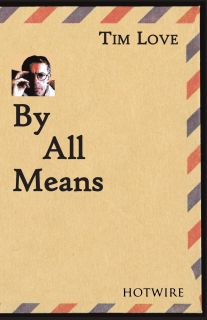 My story collection "By All Means" (ISBN 978-0-9570984-9-7), published by Nine Arches Press, is on sale from
  My poetry pamphlet "Moving Parts" (ISBN 978-1-905939-59-6) is out now, on sale at the


